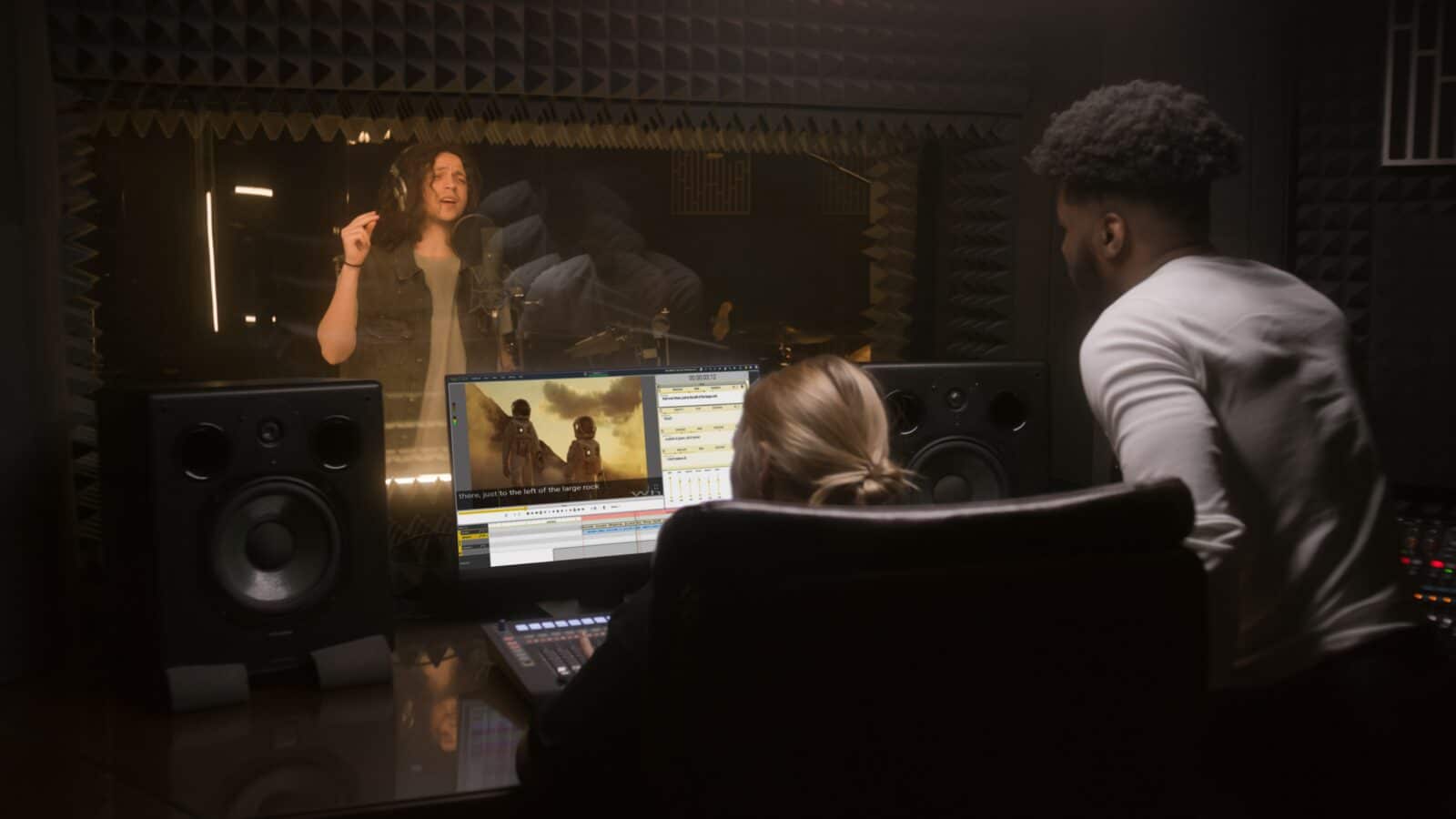
Hybrid Dubbing Workflows: Combining Human Expertise, Automation and Best-of-Breed AI
Hybrid dubbing workflows combine human talent, AI voice generation, speaker diarization, workflow automation, and intelligent project management into a unified production environment. Discover how The Stellar Suite orchestrates every stage of the dubbing process to increase efficiency, reduce costs, accelerate multilingual content delivery, and scale production without compromising quality.
The dubbing industry is undergoing a fundamental transformation.
For decades, dubbing followed a relatively linear process: scripts were translated, voice actors recorded in physical studios, audio engineers mixed the final tracks, and project managers coordinated every step through emails, spreadsheets, and manual handovers.
Today, content volumes are increasing rapidly while turnaround times continue to shrink. At the same time, new technologies such as AI translation, speaker diarization, synthetic voice generation, voice cloning and voice morphing are creating entirely new production possibilities.
Yet despite the rapid adoption of AI, most organizations are discovering that there is no single “AI dubbing workflow.” Some projects require human voice actors. Others can leverage synthetic voices and voice morphing. Some benefit from AI-assisted translation and adaptation, while others require full human review.
This is where hybrid dubbing becomes essential. The future of dubbing is not choosing between humans and AI. It is orchestrating the right combination of people, technologies, and workflows to achieve the desired balance of quality, speed, and cost.
Dubbing is no longer a linear process
Modern dubbing workflows can take many different forms depending on project requirements. A premium drama series may rely heavily on human adaptation, professional voice talent, dubbing directors, and audio engineers. A corporate training program may use AI-generated voices with minimal human intervention. A broadcaster may use human voices for main characters while generating synthetic voices for secondary roles or last-minute content updates. The challenge is no longer producing audio. The challenge is managing increasingly complex production workflows while maintaining consistency and quality.
AI-Assisted translation and adaptation
Translation is often the first stage where automation can deliver significant efficiency gains. Speech recognition can automatically generate transcripts from source media, while speaker diarization identifies and separates individual speakers within the content. Rather than receiving a single block of text, linguists receive structured dialogue already organized by speaker and timeline. Machine translation can then generate an initial translation draft.
Human translators and adaptors remain responsible for ensuring linguistic quality, cultural adaptation, natural dialogue flow, timing constraints, and audience suitability. Instead of starting from a blank page, they focus on refinement and creative adaptation.
The result is a significantly faster translation process without sacrificing quality.
Respeaking and AI voice production
One of the most interesting developments in hybrid dubbing workflows is the combination of respeaking and AI voice generation.
Traditionally, adapted scripts are delivered as text and then recorded by voice actors. However, timing, rhythm, pacing, and emotional delivery often require additional refinement during recording sessions. With a respeaking workflow, a linguist, audio engineer, voice actor or dubbing specialist performs the translated dialogue orally, naturally adjusting pacing, emphasis, timing, and phrasing while speaking. This spoken version can then be used to drive AI voice generation, creating a more natural final result than text-only workflows. This spoken performance becomes a highly valuable production asset.
The resulting audio can be used to:
Improve synchronization
Preserve intended performance timing
Enhance emotional delivery
Create more natural speech patterns
Drive downstream AI voice generation
Instead of generating synthetic voices directly from raw text, AI voice engines can leverage the respeaking performance as a reference, producing more natural and realistic output.
This creates an effective bridge between human performance and automated voice production.
Voice Cloning
Another important development in hybrid dubbing workflows is voice cloning technology.
Voice cloning allows organizations to create synthetic voice models that replicate the characteristics, tone, style, and identity of a specific speaker or voice actor. Depending on licensing agreements and production requirements, cloned voices can be used to generate new dialogue, update existing content, or create multilingual versions while preserving a recognizable vocal identity. Voice cloning opens new possibilities for maintaining character consistency across multiple languages, seasons, updates, and content formats.
Voice cloning can be used to:
Preserve established character voices
Create multilingual versions while maintaining vocal identity
Produce content updates without requiring new recording sessions
Accelerate turnaround times for large content volumes
Support accessibility and personalization initiatives
As with all AI technologies, human oversight remains essential. Voice cloning is most effective when combined with appropriate approvals and ethical usage policies that protect talent rights and ensure transparency.
Human Voices, Synthetic Voices, or both
One of the biggest misconceptions about AI dubbing is that organizations must choose between human and synthetic voices.
For each character, speaker, narrator, or role, production teams can decide whether to use:
A professional voice actor
A synthetic AI voice
Voice morphing technology (respeaking)
A licensed cloned voice
A combination of human and synthetic production
This flexibility allows organizations to optimize quality, speed, and budget requirements on a role-by-role basis.
Premium characters may be assigned to professional voice talent, while secondary roles, narration, updates, or localized variations can leverage synthetic voices.
The result is a far more flexible production model than traditional dubbing workflows.
Next-Generation Dubbing Production
As dubbing workflows become more flexible, production environments must evolve accordingly.
Yella supports hybrid production models where human voice actors, synthetic voices, and voice morphing technologies can coexist within the same project.
Automatic script segmentation enables dialogue to be split per role immediately after adaptation. Voice assignments can then be applied automatically, allowing recording and rendering tasks to be generated without manual preparation.
Multiple participants can work simultaneously within the same project.
Voice actors can record their assigned roles while AI engines generate synthetic voices for other characters in parallel. Audio engineers can review recordings while project managers track progress in real time.
Parallel production eliminates many of the traditional bottlenecks associated with sequential dubbing workflows.
Final mixes can be generated automatically from multiple recordings and rendered outputs, dramatically reducing manual assembly work.
Role-based workflows and adaptive interfaces
As dubbing workflows become more sophisticated, users should not be exposed to unnecessary complexity.
A translator does not require the same tools as an audio engineer. A voice actor does not need access to project management functions. A QC reviewer should see different information than a dubbing director. Role-based workflow orchestration solves this challenge.
Project managers can:
Assign tasks automatically
Track project progress
Manage approvals
Monitor deadlines
Coordinate resources across multiple projects
Voice talents can:
Access scripts remotely
Record from home studios
Receive real-time updates
Submit recordings directly into the workflow
Audio engineers can:
Access dedicated engineering interfaces
Review recordings
Perform mixing and mastering
Manage technical quality control
Reviewers and clients can:
Approve content online
Provide feedback directly within the platform
Track revisions and versions
Because every role has different responsibilities, the platform can present customized interfaces and layouts for each user type. A voice talent sees a completely different workspace than an audio engineer, reviewer, project manager, or client.
The same workflow can also be used directly inside traditional recording studios, allowing teams to combine familiar studio environments with modern cloud-based project management and collaboration.
Remote dubbing without compromising control
The traditional dubbing studio is no longer the only production environment. Voice actors can record remotely through secure online recording environment. Dubbing directors can supervise sessions in real time using integrated communication and intercom functionality. Audio engineers can monitor recordings, review audio quality, and manage technical validation remotely. Project managers maintain complete visibility across the entire production process regardless of where contributors are located.
This allows organizations to access global talent pools, reduce studio dependency, accelerate scheduling, and increase production capacity without increasing operational complexity.
For organizations that continue to use traditional recording studios, the same workflow infrastructure can be used directly within studio environments, ensuring consistency across both remote and on-site production models.
Automation at the core
The true value of AI is not individual features. It is workflow automation. Stellar’s workflow orchestration platforms can automate entire production pipelines using predefined workflow blueprints.
These blueprints can automatically:
Create projects after media ingest
Perform speech recognition
Apply speaker diarization
Launch machine translation
Route tasks to translators and reviewers
Trigger AI voice generation
Assign recording tasks
Launch quality control checks
Perform format conversions
Deliver final outputs
Rather than manually coordinating dozens of individual tasks, project managers oversee a structured and largely automated workflow. Automation handles repetitive operational activities while human specialists focus on quality, creativity, and decision-making.
Workflow Orchestration: the foundation of scalable dubbing
As AI services continue to evolve, organizations need the flexibility to integrate the best technologies available.
With The Stellar Suite, we offer a platform that can orchestrate best-of-breed AI services rather than locking users into a single provider.
Speech recognition may come from one vendor. Translation from another. Synthetic voice generation from multiple providers. Voice morphing from a specialist solution. Human contributors remain integrated wherever required.
Workflow orchestration brings all of these components together into a single controlled environment. The result is a scalable dubbing ecosystem capable of supporting human, AI-driven, and hybrid production models simultaneously. Because ultimately, the future of dubbing is not about replacing people.
It is about enabling people and technology to work together more efficiently than ever before.
The Stellar Suite: built for the future of hybrid dubbing
The future of dubbing will not be defined by a single technology. It will be defined by how effectively organizations combine human expertise, AI services, automation, and collaboration within a unified production environment.
The Stellar Suite was designed specifically for this new reality.
By combining workflow orchestration, AI integration, cloud collaboration, role-based workspaces, remote recording, and project management, The Stellar Suite enables organizations to build dubbing workflows that match their unique quality, speed, and budget requirements.
Whether your production model relies on professional voice actors, synthetic voices, voice morphing technologies, or a combination of all three, The Stellar Suite provides the flexibility to orchestrate every stage of the process within a single platform.
Rather than replacing existing technologies, The Stellar Suite connects them. Organizations can integrate best-of-breed AI providers, maintain human review where needed, automate repetitive tasks, and scale production without sacrificing quality or control.
See how The Stellar Suite can help you:
Accelerate translation, adaptation, and voice production
Combine human and AI-generated voices within the same project
Reduce studio time
Speed up revisions and pickups
Streamline collaboration between translators, voice actors, engineers, reviewers, and clients
Automate repetitive production tasks
Scale dubbing operations while maintaining quality and control
Request a demo and discover how The Stellar Suite can help you build the next generation of dubbing workflows.